San Francisco did not dig the gold. It banked it, shipped it, insured it and turned it into a city. This page follows that money through the firms, exchanges and buildings of the Financial District.
Most of the buildings shown here date from 1904 to 1924, rebuilt after the 1906 earthquake. The firms behind them go back to the 1850s and 1860s. Landmark numbers follow the official San Francisco Designated Landmarks list; see the Landmarks page for the full set.
Why a mining boom needed a bank
Gold was found in the Sierra foothills, about 120 miles inland. It was weighed, shipped, banked and spent in San Francisco. The city grew from fewer than 1,000 people in 1846 to about 25,000 by the end of 1849, and by the early 1850s it had foundries, flour mills, furniture factories, its first bank (January 1849), Wells Fargo and a branch of the U.S. Mint.
That is the argument of this site: San Francisco was the entrepôt, the place where a rush of miners became a financial centre.
Money and markets at a glance
January 1849, the city’s first bank
1852, Wells Fargo opens in San Francisco
1854, the U.S. Mint opens a San Francisco branch
1855, the first Merchants’ Exchange on Battery Street
1864, the Bank of California is founded
1904, Giannini founds the Bank of Italy
Wells Fargo: a New York company built for San Francisco
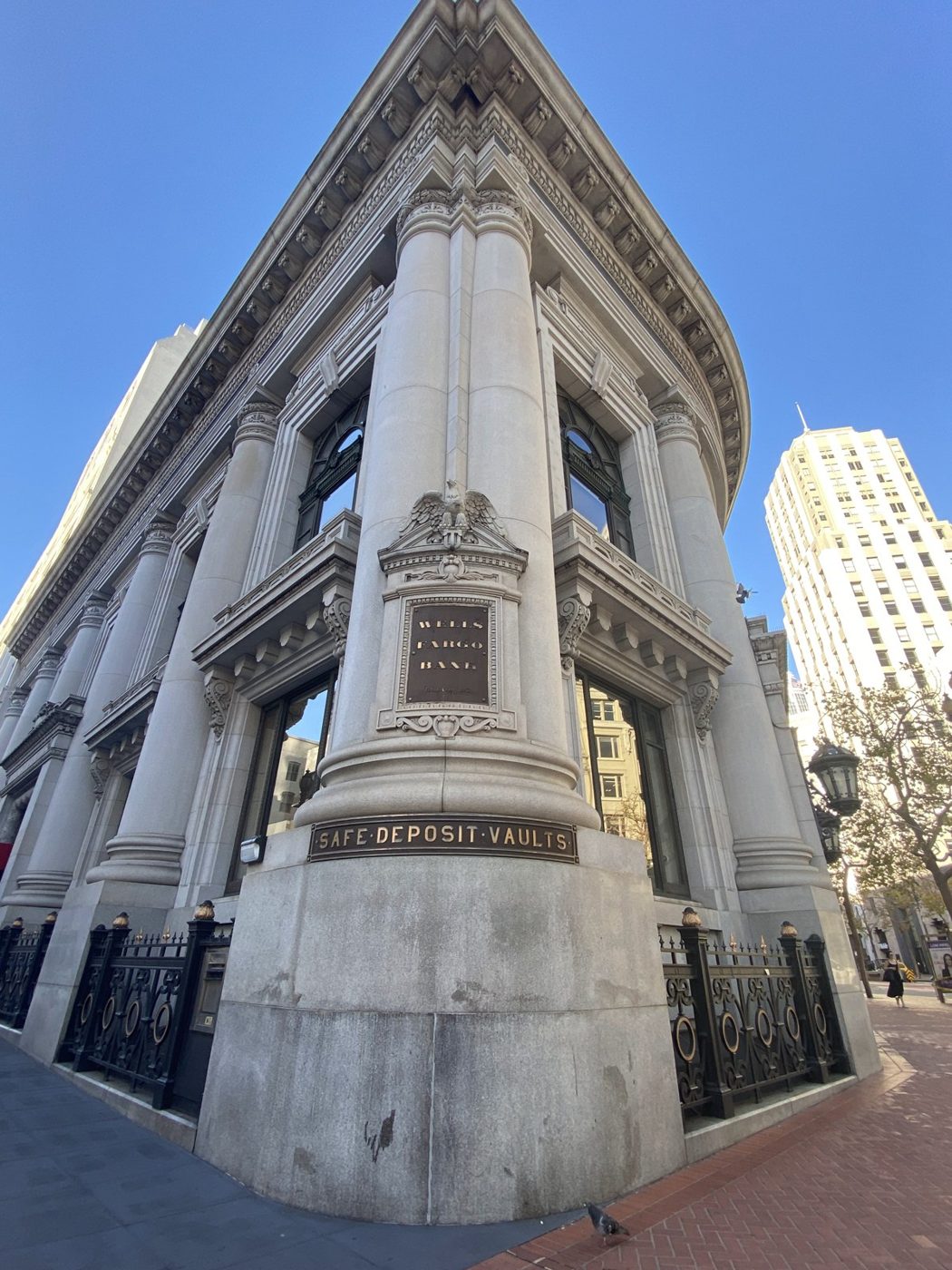
Union Trust Building, 744 Market Street
Author’s copyright
Wells Fargo & Co. was organized in New York City on March 18, 1852, by Henry Wells and William Fargo, who had also helped found American Express. It existed to serve the California gold trade. Its first San Francisco office opened four months later, in July 1852, and offices in Sacramento and the mining camps followed. One of its early jobs was moving gold from the Philadelphia Mint until the San Francisco Mint opened in 1854.
A bronze plaque on the Union Trust Building at 744 Market Street still reads “Wells Fargo Bank, Established 1852.” The building, completed in 1910 to designs by Clinton Day, is still a working bank.
744 Market St · San Francisco Designated Landmark No. 131
Giannini and the Bank of Italy
A. P. Giannini founded the Bank of Italy in San Francisco in 1904. His father had come to California for the Gold Rush. In 1918 Giannini built the first statewide branch-banking system in the United States, aimed at small farmers, immigrants and working families, the customers the Gold Rush migration had created.
After the 1906 earthquake he carried the bank’s gold and cash out of the ruins on a produce wagon and lent money from a plank-and-barrel desk on the docks. The bank became Bank of America in 1930 and by 1945 was the largest commercial bank in the world.
The building at 550 Montgomery Street, completed in 1908, was the bank’s headquarters from 1908 to 1921. It is a National Historic Landmark (1978), and the National Register nomination calls it the most significant extant Giannini building. It stands where Captain J. B. Montgomery landed in 1846.
550 Montgomery St · California Historical Landmark No. 81 (site of the 1846 landing)
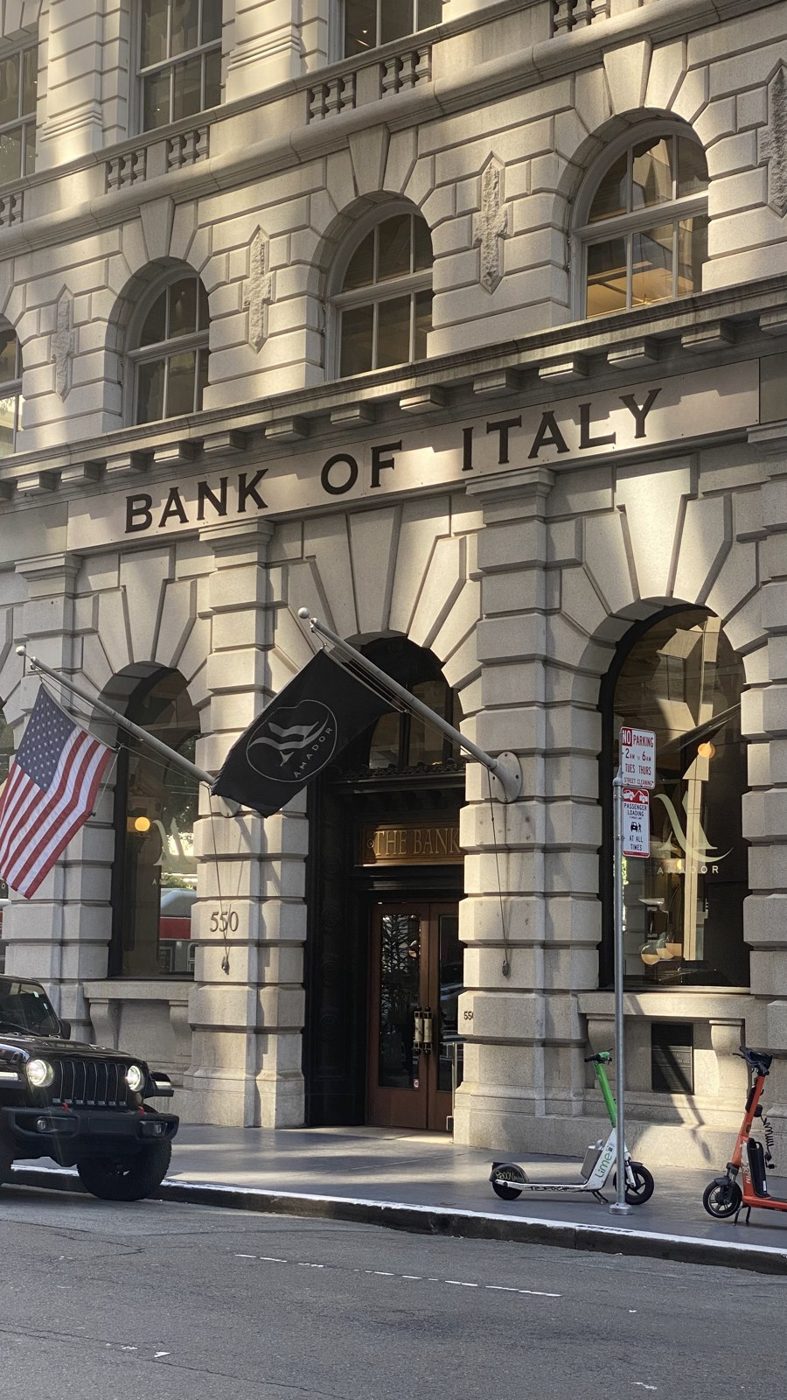
Bank of Italy Building, Montgomery Street
Author’s copyright
Ralston, the Bank of California and the Comstock
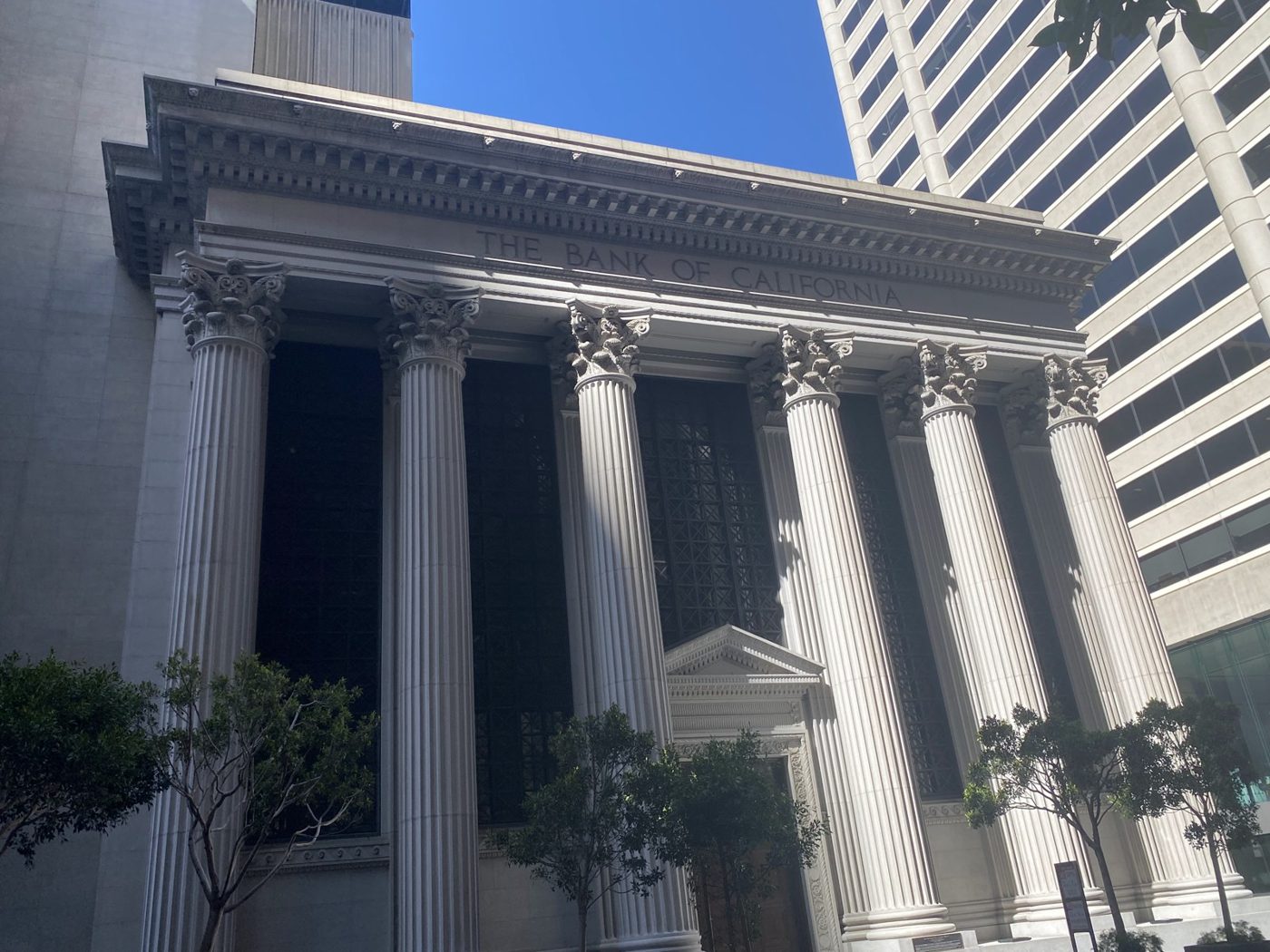
Bank of California Building, California Street
Author’s copyright
The Bank of California was founded in 1864 by William Ralston and Darius Ogden Mills. It is the oldest incorporated commercial bank in California. Ralston, called “the man who built San Francisco,” financed Comstock Lode mining operations. The bank failed in 1875 after over-extending on mine investments, and Ralston drowned the day after he resigned. The bank later reopened and merged with Union Bank in 1996.
The present building, by Walter D. Bliss and William B. Faville, dates from 1908 and replaced the 1864 building on the same site, which was destroyed in the 1906 earthquake.
400 California St · San Francisco Designated Landmark No. 3
The exchanges
Merchants’ Exchange
The first Merchants’ Exchange, opened in 1855 on Battery Street, was the commercial nerve centre of the Gold Rush city. Watchmen on the roof spotted incoming ships and passed cargo and gold news down to the merchants below. The present building at 465 California Street is the third on the site. Burnham & Polk completed it in 1904, with interiors by Julia Morgan. William Coulter’s maritime murals of 1906 are still on the walls.
465 California St
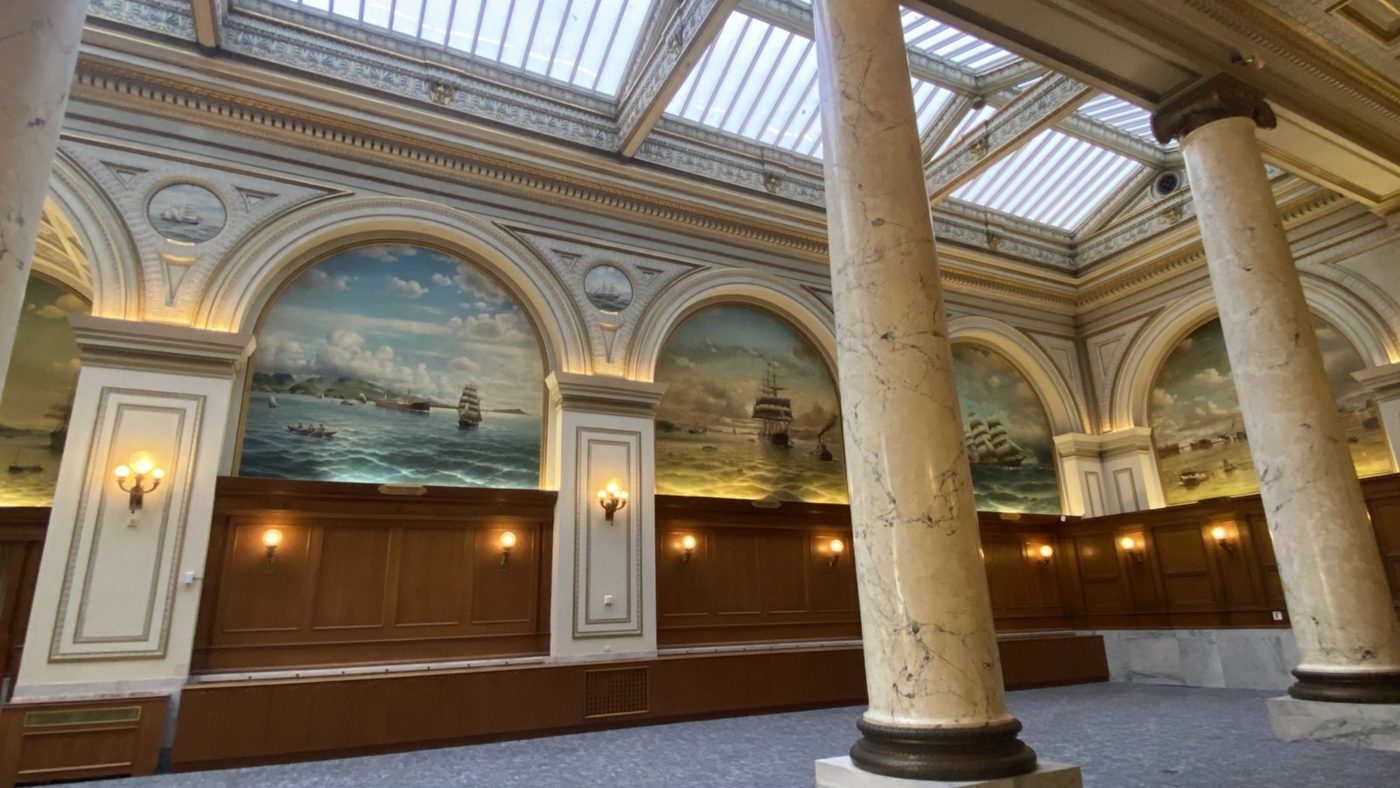
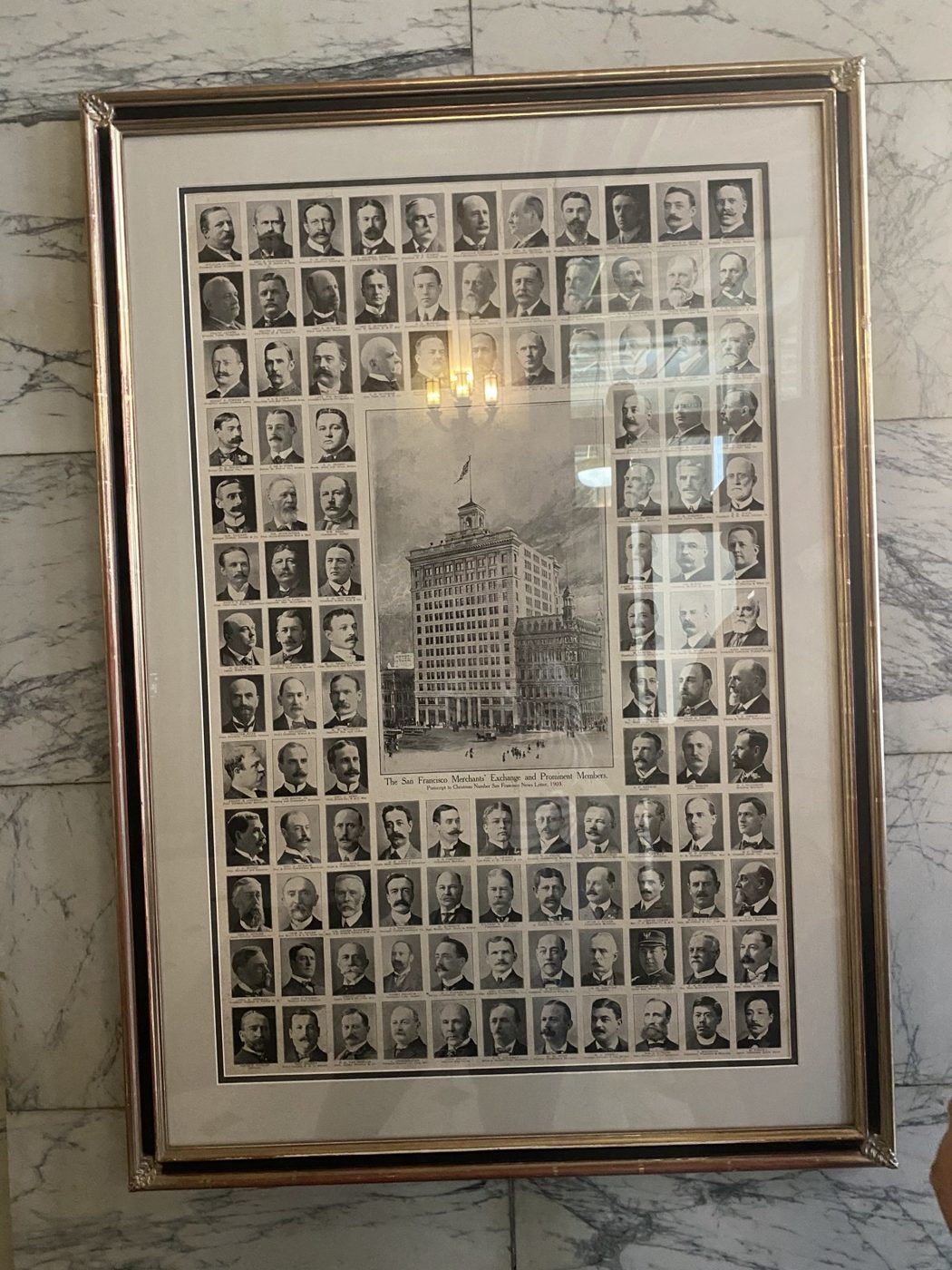
Merchants Exchange, California Street
Author’s copyright · swipe for 2 photos
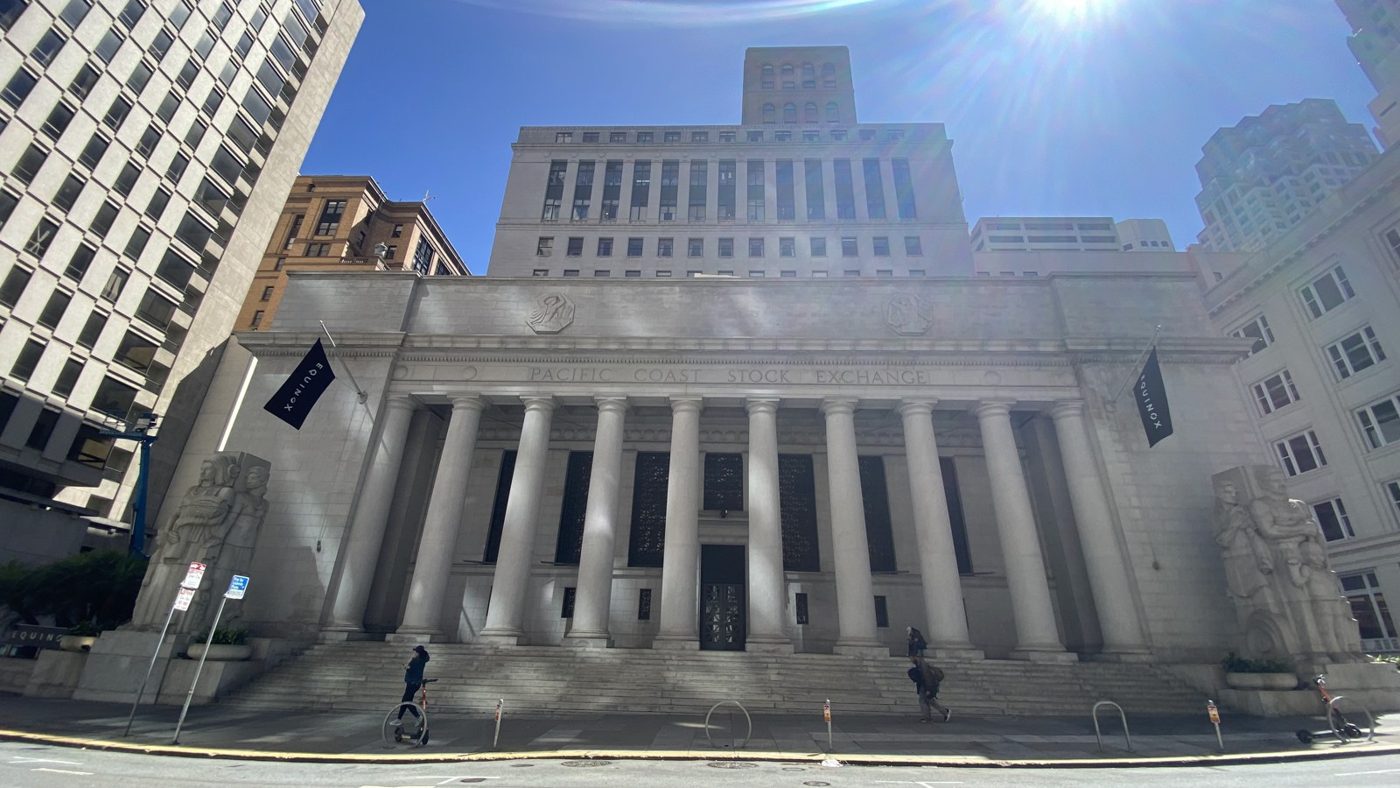
Pacific Coast Stock Exchange, Pine Street
Author’s copyright
Pacific Coast Stock Exchange
A neoclassical building by Milton Dyer, renovated in 1930 by Miller & Pflueger. Timothy Pflueger’s drawings for it are in the collection of SFMOMA. The building now houses the City Club of San Francisco and a fitness club.
301 Pine St
Sherman’s bank
William T. Sherman, later the Civil War general, set up the San Francisco branch of Lucas, Turner & Co. in 1853. In spring 1854 it moved into its own building at the northeast corner of Jackson and Montgomery streets. Sherman carried the bank through the financial crisis of 1855, and it stopped doing business in 1857. While he ran it, California’s governor asked him to command the state militia against the 1856 Committee of Vigilance. Sherman accepted two days before James King of William was shot.
800–804 Montgomery St · San Francisco Designated Landmark No. 26 · California Registered Landmark No. 453
Lucas, Turner & Co.
1853, San Francisco branch established
1854, own building at Jackson and Montgomery
1855, survives the financial crisis
1857, closes
More bank buildings on the Landmarks page
The Financial District holds more of these buildings: the former Crocker bank at 1 Montgomery Street (Willis Polk, 1908), the Old Federal Reserve Bank at 400 Sansome Street (George Kelham, 1924), the Savings Union Bank at 1 Grant Avenue (Bliss & Faville, 1910), and the preserved 1910 bank hall of the Anglo & London-Paris National Bank, with its 38-foot Doric columns, inside the tower at 1 Sansome Street. Photographs and landmark numbers are on the Landmarks page, and dates are on the Timeline.
Company histories on this page are being checked against primary sources and will be listed on the Bibliography page. Buildings shown without a landmark number have not been confirmed as designated.

